Related Posts
Not all AI chatbots exist to achieve the same goals. There are those that aim to assist you in completing some tasks, getting the necessary information, organizing things for you, or just answering a simple question.
On the other hand, some AI chatbots exist to create a more personal experience through a conversation. These distinctions matter when an AI system has memory capabilities, a specific personality, or fosters conversation. AI companions and AI assistants are created using similar technologies, yet there can be significant differences between them.
Some useful sources on the topic include Intimeros AI Companion Reviews, which look at how companions deal with issues like personality, memory, safety, and privacy.
An AI assistant is normally designed to meet practical needs. You ask it to do something, and it gives you information or helps with part of the work. Common uses include drafting text, planning a trip, explaining a topic, or helping with code.
The vast majority of people employ an assistant in order to get some answers or results. Even when the tool remembers past chats, memory is usually there to make future requests easier rather than to create a personal connection.
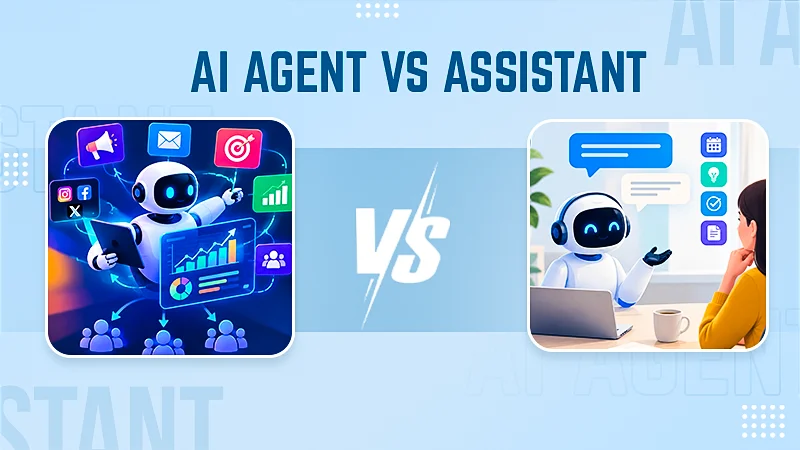
AI assistants are sometimes confused with agents because both can help users complete work. The difference between marketing AI agents and AI assistants follows a similar idea. Assistants usually respond to direct requests, while agents can take more responsibility for completing a wider task.
A virtual companion robot is created to interact continuously with a virtual personality or character, rather than to be productive.
The difference matters more as companion-style AI becomes more widely used. A 2025 nationally representative survey by Common Sense Media found that 33% of U.S. teens had used AI companions for social interaction or relationships, including conversation practice, emotional support, friendship, role-playing, or romantic interactions.
Many companion platforms use memory so conversations can continue from earlier chats. A user may talk about the same interests over time, return to an earlier topic, or build a longer role-play instead of starting from scratch each time.
Some services also let users influence the manner in which the characters communicate. Customizing a character’s behavior can make conversations feel more personal than interactions with a standard assistant.
Companion artificial intelligence does not actually experience any feelings as people do. A warm or familiar response can feel convincing, but it is still produced by a system rather than by a person who understands the relationship in the same way.
Their intended purpose is the clearest difference.
| Area | AI Assistant | AI Companion |
| Main purpose | Help with tasks and information | Support ongoing conversation |
| Typical use | Writing, research, planning | Conversation and roleplay |
| Personality | Usually neutral or task-focused | Often more defined |
| Memory | Helps with future requests | Helps conversations feel continuous |
| User relationship | Mostly functional | Can feel more personal |
| Main concerns | Accuracy and data use | Privacy and emotional boundaries |
In conversation-based AI, there could be a number of ways in which memory functions. A system might retain a user’s preferred name, interests, communication style, previous topics, or details deliberately saved for later conversations. Remembering details across conversations can make an AI companion feel more personalized, but persistent memory also makes it important to understand what information the service stores. Users should distinguish between temporary conversational context and information that a service may retain across separate sessions.
The boundary between assistants and companions can become less clear when people use chatbots for conversations that have emotional value to the user. The American Psychological Association’s discussion of AI companions examines how these interactions can become more personal and what psychological questions may arise when a chatbot starts to resemble a companion.
Privacy practices vary between AI services, so users should not assume that every assistant or companion handles conversations in the same way. There are some platforms where the chat history or memories will be stored for different durations or for different uses.
Before sharing sensitive information, users can check whether memories can be viewed, edited, or deleted, whether chat history can be disabled, and what the service says about the use of conversations for product improvement.
How the user interacts with the AI technology determines whether it functions as an assistant or as a companion. A general assistant may create a sense of familiarity when conversations become personal, and the system remembers previous interactions. The experience can resemble a dedicated AI companion, although it does not create a human relationship.
An AI assistant is usually the better choice for work, research, planning, or common questions. An AI companion makes more sense for users who want character-based interaction, roleplay, or more personal conversations.
Both types of AI have limits. They can make mistakes or misunderstand the context, despite sounding very sure of themselves.
AI assistants and AI companions can overlap in what they do, but their design priorities differ. Users should consider a tool’s purpose, memory features, privacy controls, and style of interaction before deciding which type better suits their requirements.
Ans: An AI assistant is primarily used for tasks, information, research, and productivity assistance. The AI companion is more about continuous conversation, personality, and interpersonal interactions.
Ans: The AI companion is used for conversations, roleplay, character interactions, etc.
Ans: Memory will enable the companion to recall details such as interests, preferences, or previous conversations, making future interactions seem more connected and personal.
Ans: Yes. When users talk to a general AI assistant regularly and it recalls previous conversations, the situation can resemble the use of an AI companion.