Why Healthy Online Communities Need Friction: A Practical Guide to Slow Mode, Permissions, and Moderation
Jump To Key Section
- Start With the Kind of Community You Are Running
- Slow Mode Works Best When Volume Is the Problem
- Permissions Should Match the Job the Group Is Supposed to Do
- Give Administrators the Rights They Actually Need
- Anti-Spam Automation Is a Filter, Not a Final Judge
- Topics Organize Conversation, but They Do Not Fix Conduct
- Keep the Rules Short Enough to Be Used
- Measure the Problems You Want to Reduce
- Change One Variable at a Time
- Know When Friction Has Gone Too Far
- The Better Question for Moderators
- Frequently Asked Questions
There is a clear difference between a community with 40 members and a community with 4,000. Open posting rules and conversations that keep the community active can turn into a spam group that receives thousands of notifications per minute.
Adding more operators in bigger communities is important, but this alone can not solve the problem. Moderators remove spam after it appears, but manually designing every conversation is something not even they can handle. Changing the environment is the best approach to treat these kinds of situations.
Slow down every volume posting, limit permissions that are distracting people from the group’s purpose, divide administrator responsibilities, and organize discussions to let the members know where to contribute.
This is called friction, but in a way that serves a positive purpose. Instead of making participation difficult, this encourages thoughtful participation and limits a noisy crowd.
| TABLE OF CONTENTS Slow Mode Works Best When Volume Is The Problem Permissions Should Match the Job The Group Is Supposed to Do Give Administrators the Rights They Actually Need Anti-Spam Automation Is a Filter, Not a Final Judge Topics Organize Conversation, but They Do Not Fix Conduct Keep the Rules Short Enough to Be Used Measure the Problems You Want to Reduce Change One Variable at a Time Know When Friction Has Gone Too Far The Better Question for Moderators |

Start With the Kind of Community You Are Running
Before changing a setting, describe what the group is for.
A public support community requires a different rhythm from a small project team. A hobby group may allow images, links, polls, and casual conversation. An announcement-focused community may need most members to read instead of post.
Problems often start when administrators copy the same permission model from one community to another.
A useful first question can be: What behavior does this community need to succeed? Once that is clear, settings become convenient to justify.
Slow Mode Works Best When Volume Is the Problem
Fast-moving groups can become hard to follow even when nobody is significantly causing problems. Four separate messages – “Hi,” “Quick question,” “Anyone here?” and “Need help” – create more spam than one complete question.
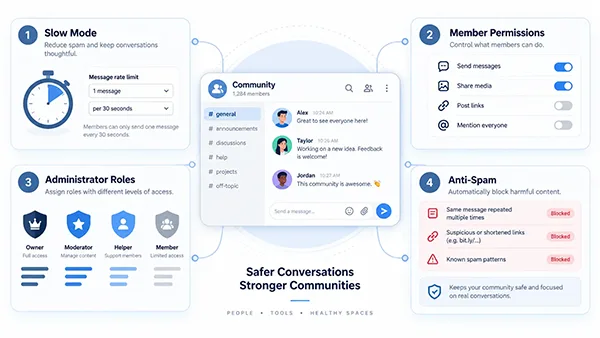
Telegram’s Slow Mode lets administrators limit how often regular members can post in a supergroup. Used carefully, that delay encourages people to collect thoughts before sending them and can make busy conversations easier to read.
It is useful in large Q&A communities, event chats, public communities, or periods when activity suddenly spikes. It is a poor fit for situations that rely on rapid back-and-forth communication, such as a small incident-response team or live coordination community.
Think of Slow Mode as a pressure valve, not a punishment.
Permissions Should Match the Job the Group Is Supposed to Do
Large groups rarely need every member to have every capability.
Telegram allows administrators to set default permissions for what members are able to send or do. A help group may allow screenshots but eliminate promotional links. An announcement-heavy community may limit posting at all. A discussion group may stay open while limiting actions that routinely create moderation work.
Regional resources can still help users understand the platform without switching the governance model. Traditional Chinese readers in Hong Kong and Taiwan who want platform-specific background can consult this 紙飛機聊天軟體 resource; the moderation principles themselves remain the same regardless of interface language.
The useful rule should sound like: if the group’s purpose does not need permission, administrators should at least question why it is enabled.
Give Administrators the Rights They Actually Need
Another common approach is to make every moderator a full administrator.
That is convenient at first, but it creates avoidable risk and makes responsibility harder to track. Telegram supports granular administrator rights, including specific controls for tasks like deleting messages, banning users, inviting members, pinning content, and managing topics.
A larger community can divide those roles. One moderator should pay attention to spam and abusive behavior. Another can maintain pinned resources and topic structure. A community manager works best for handling onboarding.
This follows the security principle of least privilege: people should have enough access to do their work, but not automatically receive every administrative capability.
Anti-Spam Automation Is a Filter, Not a Final Judge
Bigger Telegram supergroups can enable Aggressive Anti-Spam, which uses Telegram’s native anti-spam technology to identify and remove suspected spam.
That can decrease repetitive workload, especially in public groups. It should not suppress human review.
Language is another problem. Regional slang, legitimate URLs, repeated event information, or unnecessary posting patterns can look suspicious without context. Telegram’s system even offers a way for administrators to report false-positive deletions.
A sensible model is layered: automation handles regular patterns, while people review edge cases and context. Blind trust in a filter is not a dependable strategy.
Topics Organize Conversation, but They Do Not Fix Conduct
Once a group expands, different discussions compete for the same timeline. Technical questions, event announcements, feedback, normal chat, and resources can quickly become crowded.
Topics help solve that information-architecture problem. Telegram allows supported groups to separate discussions into topic areas with their personal history, shared media, and notification context.
A common structure might include Help, Announcements, Events, Resources, Feedback, and Off Topic. The aim is to create a topic for every possible subject, but too many choices make new members hesitate and burden moderators to move posts regularly.
Topics also do not solve unacceptable behavior. Spam posted in the correct topic is still spam. Structure and moderation support each other, but they are not substitutes.
Keep the Rules Short Enough to Be Used
A rulebook often points one incident at a time. Someone posts an affiliate link, so a paragraph is added. Someone talks about spoilers, so another paragraph appears. Six months later, new members are welcomed by a wall of text.
Detailed policies can be useful, but onboarding should answer only the questions people need to know immediately:
- What is this community for?
- Where should I post?
- What is clearly prohibited?
- Are promotions or links allowed?
- What happens if a rule is broken?
Every other thing can live in a longer reference document.
The best first-minute experience is not the one with the most perfect policy. It is the one that helps a reasonable person participate correctly without solving riddles.
Measure the Problems You Want to Reduce
Ban counts are easy to map and poor measures of community health.
A good review always asks how many repeated questions appear, how much time moderators spend removing the same type of spam, whether member reports are resolved, whether newcomers find the right topic, and whether important questions receive useful replies.
If moderators are deleting the same type of post every time, speed may not be the real problem. A permission change, clearer onboarding, or better niche structure may eliminate the cause.
This is where moderation starts to feel more like product design than policing: observe the recurring problem, discover the behavior behind it, then change the environment accordingly.
Change One Variable at a Time
Community managers sometimes react to a bad week by changing everything at once: Slow Mode, posting permissions, admin roles, topic structure, and anti-spam controls.
That makes the result impossible to calculate.
A better approach is to initiate with a short baseline. For several days, record message volume, repeated posts, spam incidents, complaints, and moderator supervision. Then change one relevant setting and watch the results.
If a modest Slow Mode interval decreases fragmented posts without damaging useful discussion, keep it. If link restrictions stop spam but also affect legitimate support resources, change the rule.
Moderation settings are operating choices, not moral decisions. They should change when the evidence says they are not useful.
Know When Friction Has Gone Too Far
The reflected failure is a community so controlled that participation becomes overwhelming.
If members wait too long between messages, cannot present legitimate resources, face confusing permissions, and have to choose between 20 nearly identical topics, spam may fall – but so may every worthwhile discussion.
The goal is not maximum restriction. It is the minimum amount of friction required to protect the community’s motive.
That threshold will be different between a 50-person hobby group and a 20,000-member public community. It may also change with time.
The Better Question for Moderators
Moderation is often pictured as an administrator watching a feed and deciding what to delete. In practice, communities that are operating well do much of their moderation before they send a message.
Slow Mode influences posting patterns. Permissions define what members can do. Administrator roles restrict who can change the environment. Anti-spam systems reduce repetitive abuse. Topics give discussions a place to live. Clear onboarding prevents avoidable disturbance.
None of these tools creates better culture on its own. People still need judgment, fairness, transparency, and space for normal disagreement.
Instead of questioning only, “How do we remove bad content faster?” community managers should also ask:
“What can we change so that useful participation is convenient, and disruptive behavior takes more effort?”
That is the type of friction that can make an online community healthier rather than significantly quieter.
Frequently Asked Questions
Ans: Slow Mode in Telegram limits how many messages members can send at a particular time in a group. It reduces spam and keeps the discussion organized.
Ans: Administrators should limit member permissions to prevent spam, misuse, or unnecessary moderation work.
Ans: Administrators should assign permissions based on each moderator’s responsibilities. This follows the principle of least privilege and improves group security.