Best Free Photoshop Alternatives
Adobe Photoshop has been considered the best photo processing software for years. It can enhance photos very well along with many features; however, it also costs a lot, and after paying a lot, it still can’t enhance the photo according to the price.
So, there are some Adobe Photoshop alternatives that you can use to enhance your images. In this article, you’ll see those alternatives that provide you with many features that can be the best alternate from the paid tool.
1. Luminar on Web: Easy Browser-Based Photo Editing
Luminar on Web is worth evaluating among the best Photoshop alternatives for beginners who want to edit images online for free. Its free plan incorporates RAW support and necessary adjustments for light, color, detail, and tones, without a desktop placement.
Premium tools streamline tasks such as sky replacement, skin retouching, and portrait background blur. Light Depth offers lighting alteration based on scene depth, while presets and filters help you inspect different styles.
Web Full Access includes superior editing tools, Luminar on Mobile, and cross-device editing. All Platforms also adds the desktop software. Check the official website for current prices and offers.
| Pros | Cons |
| Tools for enhancing portraits and landscapes in a browser. | Focuses on photo editing instead of Photoshop’s broader illustration and graphic-design workflows. |
| Light Depth adapts lighting based on scene depth. | Free exports are limited to 1280 pixels on the longest side. |
| Sky AI, Bokeh AI, and other premium tools simplify particular editing tasks. | Several AI tools, presets, and filters need paid access. |
2. Pictius: Meticulous and Controlled
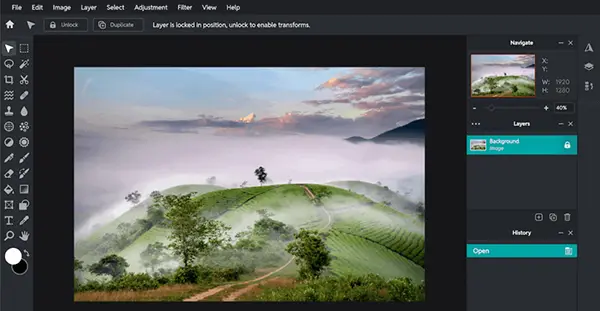
If you want a free Photoshop alternative that will not settlement its complete hands-on strategy, consider Pictius. This app includes layers, masks, selective modification, and various brush types that most advanced photographers will appreciate. It supports the PSD format to guarantee a smooth software transition. Its brush generator supports pen pressure, which is useful for photographers who also create digital artwork. Automatic retrieval helps restore documents after an unanticipated browser-tab closure. This editor processes photographs locally, making it useful when working with private or unissued client images. It is 100% free.
| Pros | Cons |
| Content-Aware Fill and AI Fill remove unwanted components for balanced compositions. | Some Photoshop-specific effects and features are not duplicated exactly when opening PSD files. |
| There is batch refining for repetitive tasks. | Its interface is currently English-only, which may be annoying for some international users. |
| The program is especially good for processing complex edges and hair. | Large, high-resolution, multi-layer files can lag or stress lower-end computers or mobile devices. |
3. PhotopixPro: Perfect for Teamwork
This online Photoshop alternative includes Photoshop-style tools, keyboard shortcuts, and support for stacked PSD and PSB files for free. It is especially useful for photographers who receive stacked projects from other people and need to make changes without Photoshop. It supports many file formats, containing RAW pictures from the most common camera brands — Nikon, Canon, Sony, etc. Traditional polishing tools, such as Clone Stamp and Spot Healing Brush, are available.
| Pros | Cons |
| PhotopixPro allows for free commercial use. | The program’s connection with the most common desktop browsers is still being tested. |
| Users can export edited files without watermarks or ads. | It does not automatically save projects, so users need to save their work automatically. |
| The files are treated locally, which is important if you prioritize privacy. | There are no generative tools or other AI-based edits. |
4. WebPixEdit: Good for Blending and Selective Tweaks
This editor is specifically suitable for photographers who want to combine several images, make local adjustments, or retouch individual areas in likeness. Its desktop-style connection with layers, masks, and selections is much easier to access than in Photoshop because WebPixEdit is accessible online and free.
| Pros | Cons |
| There are layer groups and 16 blend modes for connecting photographs. | Its 40-layer limit may become limiting when working on elaborate compositions. |
| Keyboard shortcuts that follow traditional desktop editing conference. | Some Photoshop elements, including smart objects, cannot be edited directly. |
| There are 19 filters and 20 adjustment tools: Clone Stamp, Healing Brush, Dodge, Burn, etc. | Unconverted work is lost when the browser page closes. |
Conclusion
You do not need to master every element or follow the most popular choice to create images you are proud of. The right tool is the one that advocates your ideas and makes your workflow feel natural. Before engaging with a new editor, put it through its steps with a few real projects. Try different techniques, explore its limits, and see what feels right. Choose your favorite free substitute and start creating something worth distributing today!
FAQs
Ans: Luminar, Pictius, PhotopixPro, and WebPixEdit are some of the best alternatives to Adobe Photoshop.
Ans: Luminar tools enhance portraits and landscapes in a browser, Light Depth adapts lighting based on scene depth, and other premium tools simplify particular editing tasks.
Ans: WebPixEdit is mainly used for combining several photos, making local adjustments, or retouching individual areas.