Retirement Decisions Before Moving 401(k) Money Into Gold

Precious metals are nowadays creating a lot of buzz. If you think the reason is market volatility, you might be wrong. Many retirement savers are searching to park some of their 401(k) money into gold as a way to diversify their holdings. But before you shift your entire 401(k) into a gold investment, there are some important things that you should keep in mind. Read the full blog to learn more.
Account Rules Come First
One of the first things to understand is whether or not the money you want to move is in an active workplace retirement plan. Active plans might have rules around what’s called an in-service distribution, which is taking money out of your workplace plan before leaving your job. Money in former employers’ retirement plans often comes with fewer rules.

Also, each plan has rules around what kinds of retirement accounts you can move your money into, for example, a traditional IRA. These rules are spelled out in plan documents, which you can request from the plan’s recordkeeper. It’s actually important to review these rules if you have a workplace account that provides investment opportunities not available in an IRA, such as after-tax money or company stock. You might not be able to move these types of investments to a new account.
Depending on the type of workplace needs account you have, you may also need to consider whether or not all of the money has vested.
For instance, in some 401(k)s, it can take employees a number of years before they’re allowed to own all of the employer match. You’ll also want to see whether or not there are any outstanding loans in the account, as they may have to be repaid before changing the account. Leaving a loan when closing an account could result in a taxable distribution.
All of this can get difficult. If your account has employer stock or any after-tax contributions, it’s best to work with a fiduciary adviser or a tax professional to make sure you know the best option for your situation.
What Does Gold Ownership Inside an Account Mean?
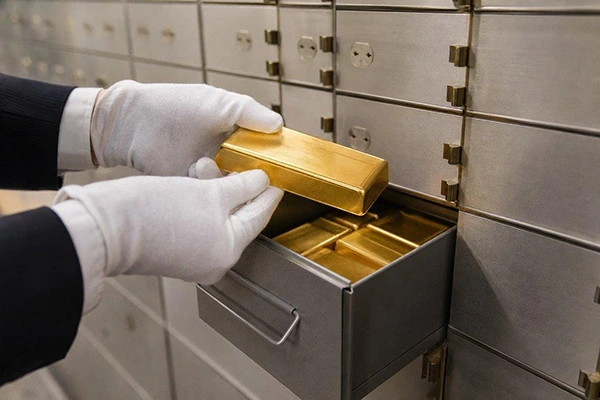
One of the significant differences between putting money into gold in a retirement account versus a brokerage account: You can’t own it in a “safe” under your bed. Retirement account rules protect you from storing retirement account gold at home, and even a bank safe deposit box will not cut it. Rather, any gold in a tax-advantaged retirement account has to be stored by a third-party custodian. This is the same as when you have a custodian bank holding your 401(k), except that precious metals companies act as custodians.
There are also rules around the kinds of gold you can keep in a tax-advantaged retirement account. In short, it has to meet some purity standards.
Transfers, Rollovers, and Taxes
Here’s what you should know about transfers, rollovers, and taxes:
Direct Transfers and Indirect Rollovers
- A rollover lets you transfer money between retirement accounts. If you plan to roll your 401k over to gold, understanding how the rollover process works is an essential first step. There are two main methods:
- A direct transfer is the way of sending money directly from one custodian to another. Since the money doesn’t change hands to you personally, it is the easiest and least error-prone option.
- With an indirect rollover, commonly known as a trustee-to-participant distribution, the funds are distributed to you. You must then keep the money in a qualifying account within 60 days. Missing the deadline would result in taxes and expected penalties.
Another wrinkle: Taxes may be taken from an indirect rollover, which would leave you short of the amount you started with. You would need to come up with those extra funds to roll the entire amount.
Tax Considerations
It’s unlikely you’ll owe taxes if you’re shifting money from a workplace account into an individual retirement account, also known as an IRA. But there’s one condition where taxes can come into play: Converting money from a tax-deferred retirement account into a tax-free one. This would be the case, for instance, if you wanted to move traditional 401(k) money into a Roth IRA. That conversion would be considered taxable income.
Costs, Performance, and Due Diligence
There are certain factors worth considering, such as costs, performance, and due diligence.
Fees

ALT Text: Gold Investment
There are many different kinds of fees associated with a precious metals IRA: Initial fees to set up the account, dealer markup when you’re purchasing gold, annual account fees, storage, insurance, shipping, liquidation fees, and more.
Before you shift any money, get an itemized fee schedule in writing from any precious metals salesperson or brokerage. Ask about any extra costs you could be on the hook for, especially when it comes time to sell. Compare all-inclusive prices among providers. Fees can add up, which could be a bigger drag on smaller accounts and a strategy that includes frequent trading.
Gold Performance
Gold is a tangible asset that doesn’t pay you dividends, so you’d be creating money on an investment by owning it easily through appreciation. But its value can stagnate and decline like other asset classes. Plus, if you sell the metals, dealers may charge a fee and provide you with less than the value of gold (bloomberg.com/quote/XAUUSD:CUR is the page I keep coming back to) at the time of your sale.
Questions Worth Asking
There’s nothing wrong with good old-fashioned due diligence before making any financial decision. And that’s doubly true with a less-common investment like a self-directed retirement account that keeps tangible assets. Ask about the custodian, storage locations, and costs. And don’t be afraid to take it back if you feel pressured to make a decision. Take your time and be wary of sales pitches that prey on fears of an impending financial apocalypse.
Portfolio Fit Matters
Gold is an alternative investment, meaning it’s an option to have as a slice of your overall retirement portfolio. Shifting all of your savings into gold would leave your investment portfolio heavily concentrated in one asset, which comes with significant risk.
If you’re thinking about retiring soon and will be depending on savings to make ends meet, consider how much of your portfolio needs to stay in investments you can quickly turn into cash. Selling physical gold could mean waiting out the market to get the best price, which isn’t useful if you need to sell during a downturn.
At the end of the day, you’ll need to make sure you’re making the move into gold because you’re comfortable with the investment. If it feels confusing or rushed, pull up a chair and slow down.
FAQs
Ans: Almost 7% of Americans have $1,000,000 in their retirement account.
Ans: About 9 to 12% of Americans have $500, 000 in a 401 (k).
Ans: Gold is a tangible asset that doesn’t pay you dividends, so you’d be creating money on an investment by owning it, easily through appreciation. But its value can stagnate and decline like other asset classes.