Best OBD GPS Trackers in 2026: A Buying Guide
Most people consider the best OBD GPS tracker as those which one that plugs into the car in a couple of minutes, updates its location every few seconds, and lets you cancel as needed. Every other feature, such as engine codes and driving scores, is an additional part that matters more or less depending on why you are buying one.
People buy it for themselves for widely different reasons. For instance, a teenager got his license, a parent in their seventies still drives to the store every day, a car listed on Turo spends weekends behind the wheel, and a small business has three trucks and one owner who wants to know they are where they should be. In all these cases, the goal is just the same, and that is knowing where your car or truck is, without assuming.
Read the full blog to learn what actually separates one plug-in tracker from another, then compare four popular options by monthly fee, update speed, and the kind of driver each one suits best.
What Is an OBD GPS Tracker?
Every car and light truck sold in the US since 1996 has an OBD-II port, a small diagnostic socket often tucked under the dashboard near the steering wheel. Mechanics use it to read engine data. An OBD GPS tracker plugs straight into that same port, gets power from your car, and uses a built-in cellular connection to send its location to an app on your phone.
That design has three actual advantages. There is nothing to wire and no tools involved. There is no battery to charge, ever. And because the tracker fits on the diagnostic port, many models can also check engine codes, battery voltage, and fuel level.
If you have never looked for your port, this guide on how to find your OBD-II port shows the most common spots.
The trade-off is visibility. An OBD tracker sits in a known location, so anyone who knows where to look can unplug it. That is why an alert when the tracker is unplugged is important almost as much as the tracking itself.
What to Look for Before You Buy
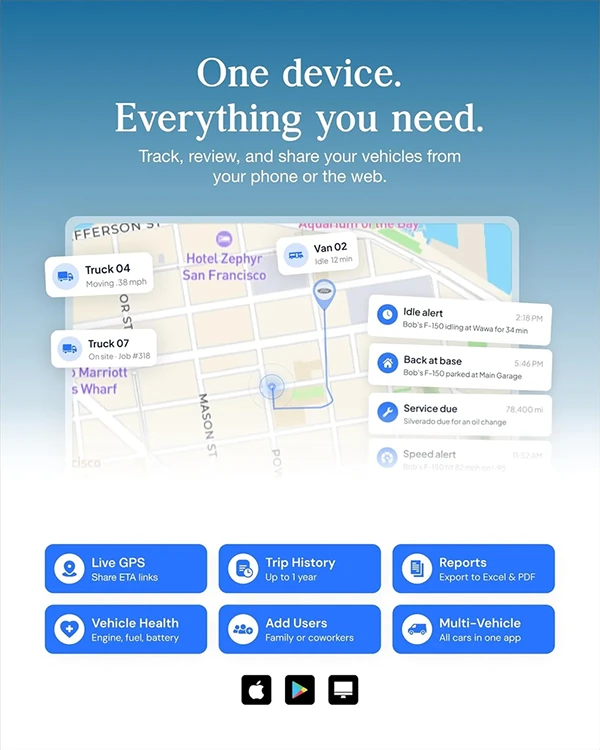
Most buyers ask the same five questions, mostly in this order. They make a good checklist.
1. Is there a monthly fee?
Almost always, yes. A tracker requires a cellular data connection to report its location, and that connection costs money. What differs is how you pay (monthly, quarterly, or yearly) and whether you are signing a contract. The one thing worth getting is a plan you can cancel without a penalty. Some brands advertise a low rate that is only applicable if you commit to two years up front.
2. Does it need a SIM card?
Not one you buy for yourself. OBD trackers ship with a SIM built in, and the data plan is part of the subscription. It does not use your phone’s data plan. The better question is which networks the tracker can use. A tracker that can switch between various carriers holds a signal better on rural roads than one tied to a single network.
3. How hard is it to set up?
With a true plug-in tracker, not difficult at all. You find the port, push the tracker in, open the app, and activate it. Expect a couple of minutes. If a product requires to be spliced into wires behind the dash, it is a hardwired tracker, which is a different category.
4. How does the subscription work?
Look for three things: a free trial or return window long enough to test the tracker on your actual routes, a clear way to cancel, and an optional discount for paying later. Prepaying should save you money, not lock you in.
5. How often does it update?
This is where trackers vary most, and it matters more than a spec sheet makes it look. A car at 60 mph covers a mile every minute. A tracker that updates every 60 seconds can show your car a full mile behind where it really is. At 15 seconds, the gap reduces to about a quarter mile. For confirming that a teen made it to school, either may be okay. For following a car in real time, faster updates make an actual difference. Also check whether fast updates come standard or cost extra, since several brands reserve their quickest refresh rate for their most costly plan.
Alerts, trip history and the app
The features you will use day to day are alerts and trip history. It’s important to have: an unplug alert, ignition alerts, geofences (a notification when your car leaves or arrives somewhere you choose, like home or school), speeding alerts, and a trip history you can replay. If you can, download the app and look around before you buy. You will open it far more often than you will ever think about the hardware.
The Best OBD GPS Trackers, Compared
| Tracker | Best for | Device price | Ongoing cost | Contract | Live update speed |
|---|---|---|---|---|---|
| ShadowAuto | Real-time tracking on every plan | $69.90 | $12 to $15 per month | None | Every 5 seconds while moving |
| Bouncie | Lowest monthly fee | About $90 (often discounted) | About $9 to $10 per month | None | Every 15 seconds while driving |
| Vyncs | Paying once a year | Included with first year | About $80 per year (base plan), plus one-time activation fee | Renews yearly | About every 60 seconds on the base plan; faster on higher tiers |
| MOTOsafety | Coaching a new teen driver | Low upfront cost | About $20 to $25 per month | None | About every 60 seconds |
1. ShadowAuto by ShadowGPS: Best Overall for Real-Time Tracking
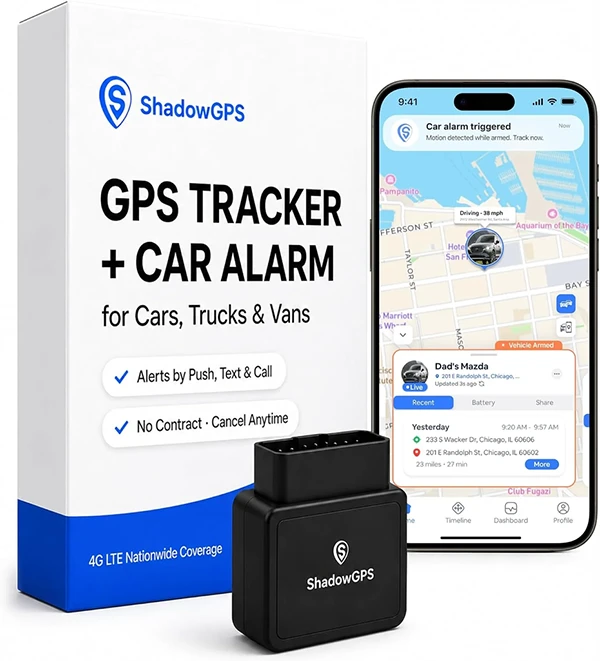
The ShadowAuto OBD-II GPS tracker updates your car’s location every 5 seconds while it is moving, on every plan instead of only the top tier. At highway speed, that is less than 150 yards between updates, close to following a car turn by turn.
Setup is about as easy as it gets. Plug it into the OBD-II port, activate it in the ShadowGPS app, and you are tracking within a couple of minutes, with no tools and nothing to charge. The tracker runs on your car’s power and uses a built-in SIM that connects to T-Mobile, AT&T, or Verizon in the US (and Bell, Rogers, or Telus in Canada), switching to whichever signal is best, with roaming when you travel.
What you get is accuracy: a live location on the map, a year of trip history you can replay, and alerts for the moments that matter, such as when the tracker is unplugged, when the ignition turns on, when your car enters or leaves a geofence, speeding, curfew, and crash events. Because it reads the diagnostic port, it also checks engine codes, battery, and fuel level.
Price and plans: the tracker is $69.90, and service runs $12 to $15 a month depending on whether you pay monthly, quarterly, or yearly, dropping to $10 a month per vehicle once you track four or more. No contract. Month-to-month, or prepay and save. Every tracker begins with a 14-day free trial.
Best for: parents of teen drivers, anyone keeping an eye on an older parent’s car, Turo hosts, and small fleets with a few trucks or vans that need one app for everything.
Worth knowing: the monthly fee is a few dollars higher than the lowest-priced plan in this guide, though every feature is included on every plan rather than being split into tiers. If you also need to track something without an OBD port, ShadowGPS makes a battery-powered tracker that works in the same app (more on that below).
2. Bouncie: Best for the Lowest Monthly Fee
Bouncie is one of the best-known plug-in trackers, and for good reason. Service costs about $9 to $10 a month with no contract, and the device lists at around $90, though it is regularly discounted. It updates every 15 seconds while you drive and adds driving-habit alerts (hard braking, rapid acceleration, and speeding), crash notifications, and engine diagnostics.
Best for: a single US-based car where the lowest ongoing charge is the priority.
Worth knowing: Bouncie is designed around its OBD tracker, so there is no battery-powered option for trailers or equipment in the same account, and service is US-only.
3. Vyncs: Best If You Would Rather Pay Once a Year
Vyncs ignores the monthly bill. You pay for a year of service up front (roughly $80 on the base plan) plus a one-time activation fee, and the device is included. It focuses on vehicle health, with engine codes, fuel reports, recall alerts, and maintenance reminders alongside trip history and geofences. New customers get a 30-day trial.
Best for: owners who want detailed diagnostics and favour one yearly payment.
Worth knowing: the base plan updates about once a minute, and faster updates charge more. Service renews each year, so put the renewal date on your calendar.
4. MOTOsafety: Best for Coaching a New Teen Driver
MOTOsafety is designed specifically for parents. Its standout feature is a daily driver report card that scores speeding, harsh braking, and rapid starts, which makes it easy to turn the data into a calm conversation about driving habits. Service runs about $20 to $25 a month with a low upfront device charge.
Best for: families who care more about how a new driver drives than about second-by-second location.
Worth knowing: location updates arrive about once a minute, the company lists the tracker as not compatible with electric vehicles, and reviewers note that cancelling needs a phone call.
When an OBD Tracker Is Not the Right Fit
A plug-in tracker is the right choice for most cars and trucks, but not for everything. Motorcycles, trailers, boats, and construction equipment often do not have an OBD-II port, and neither do cars built before 1996. Some owners also favour a tracker that is not sitting in the one spot everyone knows to check.
For those tasks, a battery-powered tracker makes more sense. It mounts with a magnet or tucks out of sight, and it runs on a rechargeable battery rather than your car’s power. ShadowGPS’s ShadowTrack works this way, lasting up to about two weeks per charge depending on settings, and it appears in the same app as ShadowAuto, which is affordable if you want to see a truck and the trailer behind it on one map.
Is It Legal to Use an OBD GPS Tracker?
In general, yes, when you track a car or truck you own. Parents monitoring a family car their teen drives and businesses tracking company vehicles are common, broadly legal uses. What crosses the line is putting a tracker on a car you do not own, or tracking another adult without their consent, which many states consider a crime. Rules for company vehicles driven by employees also vary by state, and some require written notice.
The easy rule: track what you own, and tell the people who drive it. This is general information instead of legal advice, so check your state’s laws if you are unsure.
How to Set Up an OBD GPS Tracker
- Find the port: Look under the dashboard on the driver’s side, near the steering column. In some cars, it sits behind a small cover panel.
- Plug the tracker in: Push it in until it seats firmly. It should not wobble or hang loose.
- Activate it in the app: Create your account, add the tracker, and choose a plan.
- Set your first alerts: Start with an unplug alert, a geofence around home, and a speed alert. Add more once you see how you usually use it.
- Take a short drive: Open the app afterward and confirm the trip was recorded accurately.
Bottom Line
If you want fast live updates and no contract, with every feature on every plan, ShadowAuto is the best all-round pick. If the lowest monthly fee is your priority, Bouncie is difficult to beat. Vyncs suits owners who would rather pay once a year, and MOTOsafety is designed for coaching a new driver.
Whichever you pick, a good OBD tracker should be this simple: plug it in, see it move, and cancel any time it stops being useful.