The Honest Math Of Turning A Gadget Idea Into Real Hardware
Building a hardware product isn’t that easy. Every hardware startup founder with a smart product idea thinks that the hard part is having a working prototype. They overspend, stall, and sometimes build something nobody wants in the market. Building a product takes at least 18 to 36 months.
Turning a gadget idea into a real hardware product needs a step-by-step guide and journey. It also requires a financial plan, so the bill doesn’t go above the budget. So, before investing your money in building a hardware product, make sure to take a look at the whole bill.
Why The Prototype is The Cheap Part
A prototype has just one job: to prove the concept to you. A product has a different job: work reliably in ten thousand strangers’ homes, survive shipping, pass regulators, and not burn anyone’s house down. The gap between those two jobs is where the real costs live, and almost none of them are visible from the prototype stage.
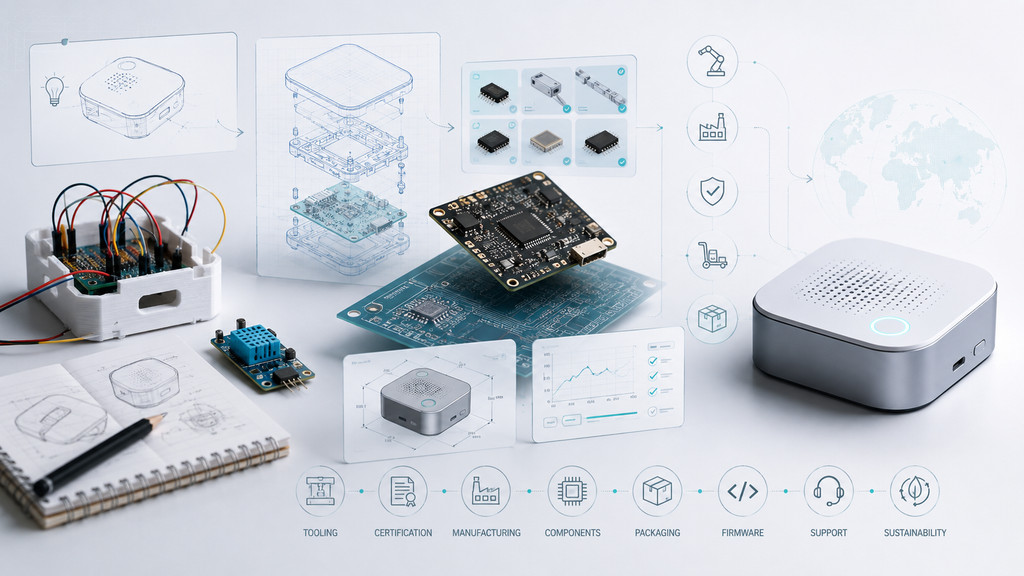
Design for manufacturing means reworking your hand-built circuit so a factory can assemble thousands of copies with acceptable failure rates, which routinely means redesigning the board entirely. Radio certification is not optional: any product with Wi-Fi or Bluetooth needs regulatory approval in every market you sell in, and before you even sell a single unit, the testing bills already land in five figures.
An injection mold for a custom enclosure is a five-to-six-figure line item that must be paid for before production starts, and changing the design afterward means paying much of it again. Add component sourcing, assembly minimums, packaging, and the support operation for returns, and the prototype starts to look like the fun part as it was before.
Three Exits That Don’t Involve Custom Hardware
Sitting with that bill, smart teams check the exits before booking the flight, and there are three exits that are worth taking seriously.
The first one is no hardware at all. If the value of your idea stays in the data or the logic rather than the object, a phone, tablet, or existing wearable may already have every sensor you need, and your product becomes software with a hardware-free margin structure.
The second is off-the-shelf internals in a simple enclosure. Industrial single-board computers and radio modules exist precisely so that low-volume products do not need custom electronics; a module that is already certified carries its radio approvals with it, cutting one of the biggest bills from the list. Most successful niche products are, internally, a standard module and a good firmware layer.
The third is white labeling: an existing manufacturer’s device, rebranded, with your software on top. Purists hate it, while accountants love it. For products where the physical object is a commodity and the service is the differentiator, it is often the correct call.
When Custom Hardware is The Right Call
Custom hardware stops being vanity and starts being strategy under specific, checkable conditions. Unit economics at real volume: once you are shipping tens of thousands of units, shaving component cost through your own board design compounds into margin no off-the-shelf module can match. Form factor as the product: custom is the only route if the device is smaller, lighter, or shaped differently than any other module. Regulated environments: medical, industrial, and automotive settings impose requirements that consumer modules were never designed to meet. And defensibility: sensing or power-management tricks that live in your own silicon choices are much harder to clone than an app.
The engineering firms serving this end of the market are built for it, and honest ones do not pretend otherwise. Yalantis, for example, runs hardware development out of an in-house lab covering industrial design, PCB design, prototyping, and firmware, a setup that exists for products headed toward production runs, compliance gates, and years of firmware support after launch.
This also depends on your plan, like if your plan is 50 units for a crowdfunding page, a lab like that is the wrong tool for you; they’re included; the fit begins where the three exits above stop working, and a firm worth hiring will check that with you before anything is signed. A vendor who takes a 50-unit custom job without asking about your volume plan is telling you something about their pipeline, not your idea.
The Budget Lines Nobody Puts in The Pitch Deck
Two cost categories deserve special mention because they arrive after launch, when the pitch deck is long forgotten. The first one is firmware for the life of the product. A connected device needs security patches and compatibility updates for as long as it is on someone’s network, which is years, and shipping those updates safely needs an update mechanism you designed in from the start. Teams that budget hardware as a one-time cost discover this line item at the worst possible moment.
The second is change management. Every meaningful hardware revision after certification can trigger re-testing, and every component that goes end-of-life forces a redesign decision on your schedule, not the market’s. Well, in a real sense, hardware companies are just like a subscription business where the customer never pays for the subscription. Price that in before you commit, not after.
A Test Before You Spend Anything
Do you want to find out whether you actually want to be in a hardware business or not? Here’s a cheap way: Read a full walkthrough of the hardware development lifecycle, the kind that covers every phase from concept through compliance to production, end to end.
Pay attention to your own reaction in the middle chapters, the ones about design transfer, certification sequencing, and supplier management. If those chapters read like an adventure, you may genuinely be a hardware founder. If they read like a warning, you have just saved yourself a tooling invoice, and one of the three exits above is the real path to market for your product.
Either answer is a win. The only losing move is finding out after the mold is paid for.
FAQs
Ans: To build custom hardware, you need a prototype, a financial plan or budget, a market where you can sell your product, engineering, testing, and mass production.
Ans: A target retail price, document inputs, outputs, processing logic, and operating environment.
Ans: BOM stands for bill of materials. This shows the total cost of all components, raw parts, and packing needed to build a single unit.