Choosing Team Uniforms for Football, Baseball and Basketball Seasons Without the Last-Minute Rush
Jump To Key Section
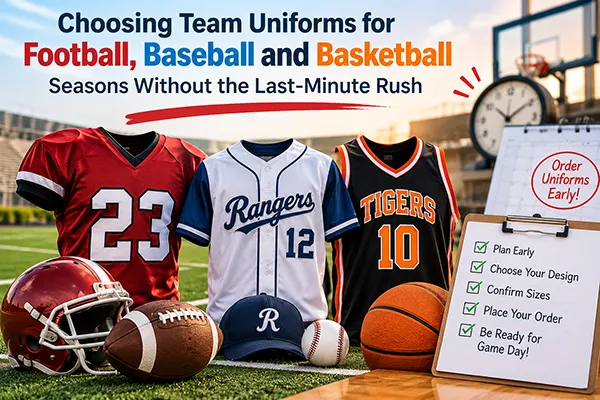
Choosing the right uniform must be another important part of your game. It is not just for appearance but also for improving performance, ensuring comfort, and reflecting the team’s identity too. Custom uniforms are not hard to buy, but they run on a production clock that starts later than most people expect, and the three big school and club sports each bring their own quirks to the order.
This article will help you to choose a perfect size and material in a uniform for your game.
The Production Clock Starts at Approval, Not at the Quote
The single most common timing mistake is computing from the day someone emails for a price. Custom team consistent makers count from the day the design proof is authorized, and the gap between those two dates is where seasons get squeezed. A quote can come back the same day, a replica can take another day, and then the roster has to be confirmed, colors agreed, and the proof signed off by someone who holds the budget.
Football shows the pattern clearly. Distributors of texas football uniforms publish a construction window of one to two weeks after the design is approved, a free model within 24 hours, and a ten-piece minimum per design. They also clarify that the clock starts at approval rather than at the quote, which is why sending colors and a team early is what protects a game date. Two designs, such as a home and an away pullover, need ten pieces each.
A practical rule for any sport is to work back from the first game. Allow a week for the quote, prototype, and approval conversation, two weeks of production, and shipping time on top. That puts the real due date for ordering roughly four weeks before the jerseys are needed, and more if a promoter club or school office has to sign off on the spend.
Football Uniforms Need the Most Decisions Up Front
Football conveys more decisions than any other team sport because the uniform is several clothes instead of one. Game jerseys, practice jerseys, pants and sideline layers can be ordered together or separately, and the fabric changes with the job. Published specs from a Texas provider describe game jerseys in 220gsm polyester with stretch web zones and practice builds in heavy-duty mesh made for daily contact.
The decorating method is the other early call. Full conversion dyes the design into the fabric, allows unlimited colors, and has nothing to crack or husk, and it is usually included in the starting price. Mended Work such as tackle twill numbers, embroidery, and sewn nameplates costs more and is quoted in a written quote. Schedule that want a traditional stitched look should ask for that price at the start instead of discovering it at the proof stage.
Youth football has its own fit needs. A true teens block, cut from youth XS up rather than contracted down from an adult pattern, sits better on younger players. Mixed sizes usually count toward the same minimum, so one crew ordering teens medium through adult 3XL in a single design can clear it in one order.
Youth Baseball Is a Sizing Problem More Than a Design Problem
Baseball jerseys look simple, and that is precisely why youth orders go wrong. The design is hardly ever the issue. The fit is, because the player wearing the jersey in July is often a size larger than the one calculated in March. A jersey that fits for half a season is a jersey purchased twice.
Producers of custom youth baseball uniforms build the cut around that problem. They add extra body length so a mid-season growth surge does not leave the jersey baiting above the belt, a deeper armhole so a young player’s swing does not bind, and flat interior joints for comfort over bare skin. Their published spec is 100% performance polyester at 3.8 to 4.5 ounces per square yard, breathable and quick-drying, with two-needle seams and bar-tack support at the collar, cuffs, and side seams.
The ordering instruction is just as useful. Send heights and weights rather than guessing sizes, because age is a weak indicator of chest size on a youth roster. Add two slim in the sizes the roster clusters around, since a jersey torn on a Saturday slide needs returning before the next game. Print numbers a size up, because relaxation fields are read from further away than their size suggests. Standard production is 10 to 14 business days after proof approval; the lowest is ten jerseys, and names and numbers are included.
Basketball Blanks Solve the Unsettled Roster
Basketball has a timing problem of its own. Many teams do not know their final schedules until tryouts finish, which makes it impossible to order numbered jerseys early. The recourse is to buy blanks, hold them, and decorate them once the roster is set.
Suppliers of blank basketball jerseys describe this use precisely. Blanks arrive with no numbers, logo, or names, and because there is no artwork stage or proof cycle, they ship several days earlier than decorated styles. They are cut from the same sublimation synthetic as decorated jerseys, come in adult S to 5XL and youth XS to XL, and sizes can be assorted freely toward a ten-piece minimum. Published pricing starts at $31.99 per jersey at ten pieces and steps down to $25.59 at 100.
Blanks also suit schools with an embrace in the building or a relationship with a local print shop. The decoration stays where it already is, and the team buys only the garment. One caution suppliers flag is that polyester can bleed color under high heat, so a low-temperature transfer is the safer choice on strong base colors. Testing on a surplus before pressing the full set takes a few minutes and can save a seared panel.
Budget Questions to Settle Before Anyone Orders
Most uniform budgets are decided by a booster club, an active director, or a parent unpaid worker, and the order goes smoother when the numbers are agreed first. Issued starting prices are usually the rate at the minimum order, which makes them the top of the range. Larger orders pay less per piece, while stitched decoration, heavier fabric, and extra garments add to the total.
Three questions save the most deliberation. How many pieces, including spares? Which decoration method, refining or stitched? And who approves the proof? Having a single named person for that last step stops a design from sitting in an inbox for a week while the construction clock waits.
Payment terms are worth verifying early too. Several team uniform suppliers send a single statement only after the design proof is approved, with nothing charged for the quote or the model before that. That arrangement suits volunteer-run teams, because the money moves once the design is final.
A Simple Pre-Season Checklist
Before the order goes in, a coach or team manager should have a final list ready. A final or near-final roster with heights, weights, and selected sizes. Team colors as specific codes or a photo of last season’s jersey. A logo file if one exists, though most suppliers will design from a depiction. The first game date, written on the reference request so the supplier can confirm what is possible.
With in hand, the rest is waiting on a clock that is now running in the team’s favor. Football programs get their replica in a day and production in one to two weeks. Teen baseball teams get jerseys that still fit at the end of the season. Basketball teams with uneasy rosters hold blanks and number them the week the lineup is final. None of it requires a rush, as long as the order starts four weeks out instead of four days.
FAQs
Ans: You should start planning at least 2 to 3 months before your first official game or practice.
Ans: Yes, always add 2 to 3 extra sets in typical team sizes. Mid-season player additions or damaged gear will ruin a game day if you have to wait for a single-item reprint.
Ans: 100% polyester or high-performance poly-blends are industry standards. They resist shrinking, wick away sweat, release red clay and grass stains easily, and hold vibrant dye longer than cotton.