How Continuous Testing Can Supercharge Your Release Pipeline

“Quality is never an accident; it is always the result of intelligent effort.”
— John Ruskin (Polymath & Writer)
Most software teams don’t struggle because they write bad code. They struggle because they discover bad code too late. IBM white paper says a defect caught in production can cost up to 30 times more to fix than one identified during development.
Yet many organizations still treat testing as a final checkpoint rather than an ongoing process. The result? Delayed releases, costly rework, and frustrated teams.
Continuous testing changes that dynamic. By embedding automated testing throughout the software delivery lifecycle, teams can detect issues earlier, shorten feedback loops, and release software faster without sacrificing quality. Here’s how continuous testing transforms modern release pipelines and why leading engineering teams consider it indispensable.
KEY TAKEAWAYS
- Continuous testing identifies defects early, reducing both remediation costs and release risks.
- Automated quality gates help maintain software quality throughout the delivery pipeline.
- Shorter feedback loops improve developer productivity and accelerate feature delivery.
- Reliable test automation enables teams to release software more frequently and with greater confidence.
Why Continuous Testing Belongs Inside Your Pipeline
Continuous testing means running automated tests at every stage of the software delivery process, not just at the end. Teams that apply continuous development and testing find that defects get caught within minutes of the code change that caused them, not days later when the trail’s gone cold. That speed changes everything about how a team responds to failures.
Tests Run in Parallel, Not in Sequence
Traditional QA workflows often create bottlenecks because test suites run sequentially after development is complete. But in a continuous model, tests run in parallel across environments the moment a developer pushes a commit. Feedback time drops from hours to minutes. Your developers don’t context-switch to a different feature and then mentally reload when a bug report lands two days later.
Every Stage Gets a Quality Gate
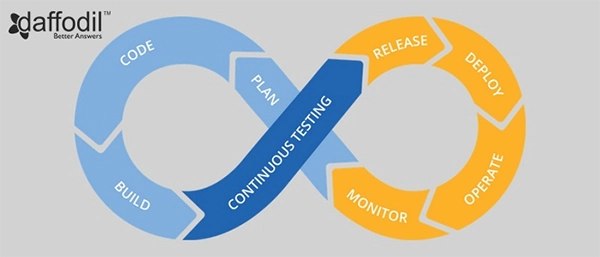
Each pipeline stage becomes a checkpoint, not just the final handoff. Unit tests fire at the commit level; automated tests run after build; end-to-end tests run before merge to main. And each gate is automated; no one has to remember to kick off a test run. The pipeline does it, every time, without exception.
If depicted visually, this is how it looks:
Failures Surface Where They’re Cheapest to Fix
The earlier a bug shows up, the cheaper it is. A unit test failure caught at commit costs minutes to investigate; the same bug reaching production can cost days of incident response, customer trust, and engineering overtime. Continuous testing creates pressure toward fixing defects at their source, which is the only place it’s actually cheap to do.
How Continuous Testing Supercharges Your Release Pipeline Speed
Continuous testing directly cuts the time between writing code and shipping it. According to the 2024 DORA State of DevOps Report, elite-performing teams deploy code 973 times more frequently than low performers. Testing automation is one of the biggest structural differences between those groups.
Shorter Feedback Loops Mean Faster Development
Fast feedback is one of the biggest productivity multipliers in software delivery. A developer who gets a test result in three minutes can fix and re-push before they’ve lost their train of thought. A developer waiting hours for results has already moved on. That’s a context-switch cost, and it doubles the time a defect lingers in the codebase. Short feedback loops don’t just feel better, they cut delivery time directly.
Fewer Manual Handoffs, Less Waiting
Manual QA introduces queues. A developer finishes a feature, waits for a tester; the tester runs through cases, writes up findings, and hands back. That cycle stretches across days. Automated continuous testing collapses the queue entirely; code gets validated as it moves through the pipeline, with no one sitting idle waiting for another team to finish their part.
Confidence to Release on Demand
And here’s what often gets overlooked: continuous testing gives teams the confidence to ship whenever they’re ready, not just on a fixed schedule. GE Healthcare, a Functionize client, cut 40 hours of test execution down to 4 hours with AI-native test automation. That’s a 90% reduction in test time; releases that used to block an entire day could move on demand. That kind of speed is a structural advantage.
Building a Continuous Testing Practice That Actually Sticks
Adopting continuous testing isn’t purely a tooling decision; you need the right test architecture and team habits. Without those, you just automate the old process.
Start With a Stable Test Foundation
Automation only works when teams trust the results. A test that fails 30% of the time for no clear reason teaches your team to ignore failures, and that’s worse than no test at all. Before you automate at scale, audit your existing tests for stability. Cut or fix anything with an inconsistent pass rate; platforms with high element recognition accuracy (Functionize achieves 99.97%) reduce flakiness dramatically because the tests don’t break every time a UI element shifts position.
Shift Tests Left Without Abandoning End-to-End Coverage
Shift-left means moving tests earlier in the cycle, closer to where code is written. That’s the right direction, but don’t gut your end-to-end layer in the process. A balanced pyramid still has unit tests at the base, automated tests in the middle, and targeted end-to-end tests at the top; shift-left reduces how many defects reach the top layer. It doesn’t eliminate it.
Measure What Your Pipeline Actually Reveals
Track mean time to detect (MTTD) and mean time to resolve (MTTR) for defects found in CI. Rising MTTD? Your test coverage has a gap. Rising MTTR? Your tests aren’t giving enough context to debug fast. These two numbers tell you whether your continuous testing setup is genuinely speeding up delivery or just generating noise.
Wrapping Up
Continuous testing is more than a testing strategy; it’s a release acceleration strategy. Getting your team to actually build it is the next step. The teams shipping fastest right now aren’t guessing; they’ve built automated quality gates into every stage, cut manual handoffs, and earned the confidence to deploy without a scheduled release window. Start with a stable test base, add gates at each pipeline stage, and measure feedback speed; the gap between where you are and where elite teams operate is mostly a testing architecture problem. It’s a solvable one.
FAQs