How Performance Marketing and Demand Generation Work Together to Drive Sustainable Business Growth
Jump To Key Section
- Understanding the Difference Between Performance Marketing and Demand Generation
- How Demand Generation Creates Opportunities for Performance Marketing
- Using Performance Marketing to Capture Existing Demand
- Connecting the Customer Journey Across Marketing Channels
- Using Data and Technology to Improve Marketing Performance
- Aligning Marketing and Sales Around Shared Business Goals
- Measuring Long-Term Growth Beyond Immediate Conversions
- Building a Connected Marketing Strategy for Sustainable Growth
- FAQs
Nowadays, businesses are operating in a highly competitive digital environment. So, attracting customers is not that easy; it requires more than running advertisements or publishing regular content. Their marketing team has to put in a lot of effort to generate leads, improve brand awareness, support sales teams, and contribute to long-term revenue growth.
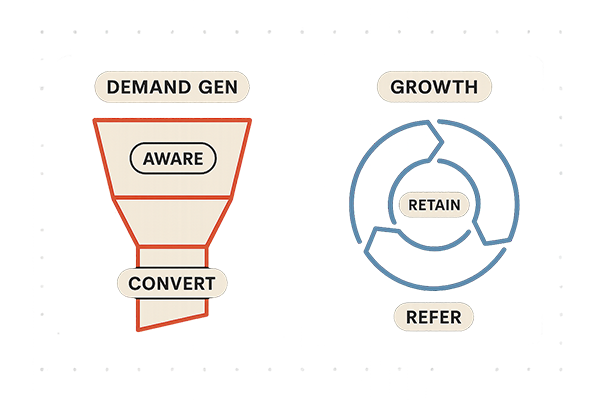
Performance marketing and demand generation are the two strategies that are playing an important role in achieving these objectives. Performance marketing focuses on measurable actions and conversions, while demand generation builds awareness, interest, and trust among potential buyers throughout their decision-making journey.
Understanding the Difference Between Performance Marketing and Demand Generation
Performance marketing is a results-oriented approach in which businesses invest in campaigns created to generate measurable outcomes. These may include website visits, form submissions, purchases, app installations, or demo requests. Paid search, paid social advertising, affiliate marketing, and display campaigns are some examples.
Its primary advantage is measurability. Businesses can monitor metrics such as cost per click, conversion rate, customer acquisition cost, and return on advertising spend. These data help marketing teams check campaign performance and allocate budgets more effectively.
Demand generation takes a broader approach. Rather than focusing exclusively on immediate conversions, it tries to create awareness and build interest in a company’s products or services among its target audience. Educational content, SEO, webinars, email marketing, social media engagement, and thought leadership all add to this process.
For instance, a B2B software company might use educational articles and webinars to introduce potential customers to a business challenge. As prospects become more familiar with the issue and start evaluating solutions, targeted advertising and conversion-focused landing pages can help them to take the next step.
Performance marketing helps convert measurable opportunities, while demand generation creates the conditions that make those opportunities possible.
Businesses looking to understand how these strategies relate to lead generation can also check the distinction between demand generation and lead generation.
How Demand Generation Creates Opportunities for Performance Marketing
Performance campaigns are usually more effective when audiences already understand a brand, recognize a problem, or have some interest in a specific solution. Demand generation helps establish this foundation.
Consider a business providing cybersecurity software. Running advertisements for a product that potential customers have never encountered might generate clicks, but visitors might not immediately understand its value.
A demand generation strategy can tackle this challenge through educational resources explaining security risks, compliance requirements, and increasing threats. As potential customers interact with this content, they become more familiar with the company’s expertise and offerings.
Performance campaigns can then target actual audiences with product demonstrations, consultations, or solution-specific offers.
Demand generation also supports audience segmentation. Businesses can check prospects based on their interests, content engagement, industry, and position in the buying journey. Performance marketing campaigns can use these insights to deliver more relevant messages rather than relying on broad targeting.
Using Performance Marketing to Capture Existing Demand
While demand generation helps in creating awareness and interest, businesses must also make it easy for interested customers to take the next step. This is where performance marketing becomes particularly valuable.
Potential customers usually turn to search engines, social platforms, and comparison websites when checking solutions. Paid search campaigns, retargeting advertisements, and conversion-focused landing pages help businesses interact with these audiences at important decision-making moments.
For example, someone searching for project management software may already understand the category and be comparing multiple providers. A targeted search campaign can introduce a relevant solution through an advertisement that addresses particular requirements.
Retargeting can further support this process by reconnecting with visitors who previously visited a website, downloaded a resource, or viewed a product page but did not convert.
Mavlers Agency runs paid search, LinkedIn, Meta, and YouTube campaigns aimed at buyers rather than clicks.
Businesses can strengthen this approach by partnering with a provider offering demand generation paid acquisition services, connecting paid search and social advertising with audience targeting, conversion optimization, and campaign measurement.
However, capturing demand should not depend completely on paid advertising. Businesses also need to strengthen their organic presence so potential buyers can identify them without encountering an advertisement every time they search.
Search visibility is also developing as buyers increasingly use AI-powered platforms alongside traditional search engines to research products and compare providers. Businesses therefore have to create visibility across conventional search results and AI-generated answers and recommendations.
By pairing paid campaigns with organic search strategies, businesses can reach audiences at different stages of intent while minimizing their dependence on a single acquisition channel.
Connecting the Customer Journey Across Marketing Channels
One of the specific challenges in modern marketing is maintaining consistency across different channels. A prospect might identify a company through a social media advertisement, visit its website after reading a blog post, attend a webinar, and later reply to an email campaign.
If these interactions operate independently, businesses might struggle to understand how prospects move from initial awareness to conversion.
Integrating performance marketing and demand generation helps make a more connected customer journey. Each channel can serve a particular purpose while contributing to the same business objective.
For instance, educational content can introduce a prospect to a business problem. Search and social campaigns can increase the visibility of that content, while email marketing can offer additional resources based on the prospect’s interests. When the individual shows stronger purchase intent, conversion-focused campaigns can encourage a consultation or product demonstration.
This needs coordination across strategy, execution, and reporting. A connected approach ensures that audience development, campaign execution, and pipeline measurement work towards the same business objectives.
Marketing automation and customer relationship management platforms can then coordinate these interactions. They allow teams to track engagement, organize prospect information, and deliver relevant communication depending on user behaviour.
The aim is not to communicate with potential customers through every available channel. It is to offer useful and consistent information at the moments when it can influence their decisions.
Using Data and Technology to Improve Marketing Performance
Both performance marketing and demand generation depend on accurate data. However, their effectiveness can be restricted when businesses measure each activity separately or work with disconnected reporting systems.
Performance marketing teams usually monitor immediate campaign metrics, including impressions, clicks, conversions, and acquisition costs. Demand generation teams might focus on website engagement, content interactions, audience growth, and brand awareness.
These measurements are useful, but they do not always describe how marketing contributes to qualified opportunities and revenue.
A connected measurement framework should think about the complete customer journey. Businesses can mix advertising data, website analytics, marketing automation, and CRM information to understand which activities contribute to prospect engagement and pipeline development.
Mavlers Agency connects marketing activity to sales outcomes so leadership can see what each channel is worth.
Technology also makes it possible to improve campaign execution. Automated workflows can nurture prospects based on their behaviour, while lead-scoring systems can help identify individuals who show stronger buying intent. AI-powered analytics can support audience segmentation, identify patterns, and help marketing teams make better decisions.
However, technology should support a clearly defined strategy instead of replacing it. Businesses need the right tracking, consistent data definitions, and regular performance reviews to ensure that marketing insights lead to practical improvements.
As Krunal Bakraniya, Director of Technology at Mavlers Agency, explains:
“AI has made execution cheaper. It has made systems, data, and judgement more valuable than ever.”
This demonstrates why businesses need to look beyond adopting individual marketing tools. The real advantage comes from connecting data, technology, and decision-making processes to improve how marketing contributes to business outcomes.
Aligning Marketing and Sales Around Shared Business Goals
The relationship between performance marketing and demand generation becomes important when marketing and sales teams work towards common objectives.
Marketing teams may create significant website traffic and form submissions, but these results do not automatically translate into qualified sales opportunities. Similarly, sales teams might struggle to turn leads when prospects have limited knowledge of the company’s offerings or are not ready to make a purchasing decision.
A better understanding of the ideal customer profile, qualification criteria, and buying journey can help address these challenges.
Marketing teams should understand the questions prospects ask during sales conversations, the objections that often arise, and the characteristics of customers who are most likely to convert. These insights can inform content development, campaign targeting, and lead-nurturing activities.
Sales teams, in turn, can offer feedback about lead quality, campaign relevance, and the resources prospects need before making a decision.
Regular communication and shared reporting help both teams detect gaps and improve their approach. Rather than evaluating success only through lead volume, businesses can assess qualified opportunities, conversion rates, sales cycle length, and revenue contribution.
Measuring Long-Term Growth Beyond Immediate Conversions
One limitation of depending exclusively on performance marketing is that short-term campaign results may not reflect the full impact of marketing activities. Some channels create immediate conversions, while others influence awareness and consideration over a longer period.
Demand generation helps businesses build relationships with audiences who might not be ready to purchase immediately. Its influence may become visible through repeat website visits, increased brand searches, content engagement, and future conversions.
Businesses should therefore use a balanced measurement framework that includes both short-term and long-term outcomes.
Performance marketing metrics, for example, cost per acquisition, conversion rate, and return on advertising spend remain important. These should be checked alongside demand generation indicators, for example, qualified pipeline, engagement from target accounts, organic visibility, and the contribution of marketing activities to revenue.
Attribution models can also help businesses understand how various interactions contribute to conversions. Although no attribution method offers a perfect view of buyer behaviour, combining available data with sales feedback can give a more realistic understanding of marketing effectiveness.
This strategy helps organizations make better budget decisions and prioritize activities that contribute to sustainable business growth.
Building a Connected Marketing Strategy for Sustainable Growth
Performance marketing and demand generation should not work as competing strategies. They are complementary approaches that tackle different stages of the customer journey.
Demand generation creates awareness, builds credibility, and develops interest among relevant audiences. Performance marketing uses good campaigns to reach prospects with stronger intent and encourage specific actions.
When supported by integrated technology, reliable data, and sales alignment, both strategies can contribute to a more predictable marketing process.
Businesses should start by identifying their target audience, understanding the buying journey, and defining the outcomes they want marketing to achieve. They can then decide which channels are best suited to creating demand and which are most effective at capturing it.
For Mavlers Agency, sustainable growth comes from connecting these activities into a system where audience development, campaign execution, and pipeline measurement support the same business objectives.
The most sustainable growth strategies are developed around this connection. Rather than focusing exclusively on clicks, impressions, or immediate lead volume, businesses can create a marketing system that supports meaningful engagement, qualified opportunities, and long-term customer relationships.
FAQs
Ans: Some examples of demand generation marketing are high-reach mass media, podcasts and community, and strategic gifting.
Ans: Digital marketing is most in demand.
Ans: The most profitable marketing is email marketing, Content marketing, and paid search marketing.