How Data Science Services Turn Raw Business Data Into Useful Decisions
Jump To Key Section
- What Data Science Services Actually Do For A Business
- From Question To Architecture. Framing The Decision Problem
- Data Collection And Engineering. Building A Reliable Decision Foundation
- Cleaning, Enriching, And Exploring Data. Turning Chaos Into Patterns
- Modeling And Prediction. Using AI To Anticipate Outcomes
- From Insights To Action. Embedding Intelligence Into Daily Decisions
- Measuring Impact: Proving That Data Science Improves Decisions
- Conclusion
- FAQs
Data Science transforms raw and scattered information into meaningful insights that help businesses make relevant decisions on time. By collecting, analyzing and interpreting complex data, data scientists uncover patterns in customer behaviour that would otherwise remain hidden.
Therefore, this article explores how data science services bridge that gap—transforming raw data into strategic actions.
Key Takeaways
- Data Science services help businesses convert raw, unstructured data into actionable insights that support decision-making.
- The data science process involves data collection, cleaning,analysis, and integrating insights into business operations.
- Reliable data engineering and governance create a strong foundation for accurate analysis.
- Measuring outcomes through experiments, performance tracking, and business metrics ensures data-driven strategies deliver real value.
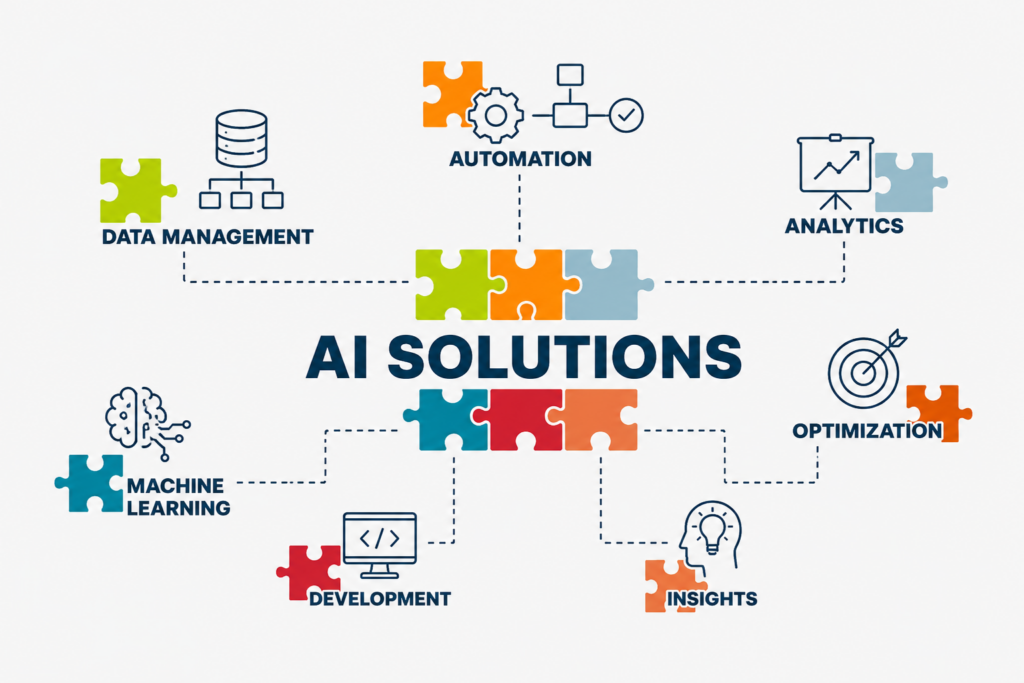
What Data Science Services Actually Do For A Business
Data science blends statistics, artificial intelligence, and engineering to answer specific business questions with proof. It follows a multi stage lifecycle from problem definition to operational deployment, covering everything from hypothesis formation to model examining.
SoftDoes positions its data science and engineering capabilities as a unified service so data models are not just prototypes but fully integrated into production systems that effectively utilize business data.
From Question To Architecture. Framing The Decision Problem
Every successful engagement starts with a sharply defined decision question. “Which customers are most likely to churn in the next ninety days and why?” is useful. “What can we do with our data?” is unhelpful.
The workflow moves from business questions to hypotheses, to data requirements, to model approach, to decision process. SoftDoes typically runs structured discovery workshops in the first one or two weeks of an engagement to document decision flows, existing reports, current bottlenecks, and regulatory needs.
Data Collection And Engineering. Building A Reliable Decision Foundation
Inaccuracies in data can lead to flawed analysis and misleading results. Data engineers design data pipelines that extract, transform data, and load it into a central warehouse or data lake using orchestration and streaming ingestion systems. The goal is a solid foundation where every event, from “checkout started” to “purchase completed,” is captured accurately.
The marketing team had been over investing in a channel based on inflated measurement. After engineering fixes removed redundant tags and corrected conversion firing, revenue alignment rose to roughly 95 percent with backend data, and budget allocation decisions changed.
SoftDoes approaches data engineering and governance together: schema design with versioning, data lineage tracking, encryption, role based access control, and audit trails that satisfy compliance requirements in finance and healthcare data science, ensuring robust support for effective operations
Cleaning, Enriching, And Exploring Data. Turning Chaos Into Patterns
Raw data from complex datasets often includes missing values, duplicate records, inconsistent time zones, and conflicting customer identities. Data cleaning addresses missing values and removes repeated. Data cleaning is critical for accurate analysis and reliable insights, because without it, even sophisticated algorithms will produce misleading results. Data cleaning ensures accuracy for meaningful insights that decision makers can trust.
Data analysts and data scientists use exploratory data analysis and data visualization to identify trends and uncover trends. Statistical analysis is crucial for transforming raw data into insights, whether that means spotting weekend purchase spikes, detecting support ticket surges after specific app releases, or finding hidden insights in seasonal customer behavior. Visualization tools like Looker, Tableau, and real time dashboards help translate raw numbers into patterns that business stakeholders can reveal. Data driven organizations see improved customer satisfaction because they respond to what the data actually shows.
When combining software development with data science services, it embeds this synergy into the product architecture: “We design applications so every feature emits the signals that future data models will require.” This philosophy ensures analytics capabilities are built into products from the start rather than added later.
Large scale data infrastructure has evolved rapidly, as reported by Ars Technica’s coverage of large scale data infrastructure, with industry leaders investing heavily in stream processing, feature stores, and real time data analysis platforms that turn data into continuous insights.
Modeling And Prediction. Using AI To Anticipate Outcomes
Predictive modeling in business terms means estimating the probability of specific results: churn, late payment, default, claim denial, or product return. Machine learning builds predictive models that improve over time by training on historical labeled data to learn patterns hidden in simple reports. Machine learning algorithms can handle vast amounts of data across large datasets, making them essential for analyzing historical sales data at scale.
Financial institutions use predictive analytics to detect fraud, and machine learning enhances fraud detection in financial institutions by identifying anomalies in transaction velocity, geography, and device patterns. Predictive maintenance reduces downtime in manufacturing by anticipating failures before they occur. Machine learning can optimize inventory management in retail by forecasting demand signals and adjusting inventory levels appropriate.
Consider a streaming service that uses viewing history, session duration, skip rates, and engagement signals to power its recommendation system. Recommendation algorithms personalize user experiences on streaming platforms by translating customer behavior inputs into model features and then into individual preferences for media. Predictive analytics enhances customer experience through personalized marketing that adjusts to each user. This kind of system is explored in depth in a recent Engadget analysis of recommendation algorithms that covers how consumer facing AI shapes content creation and exploration.
Machine learning models improve predictions from data over time, but not every decision needs a complicated model. Sometimes a well designed logistic regression or a rules engine built from earlier analysis gives clearer and more consistent business decisions. SoftDoes helps clients select model complexity based on data volume, regulatory constraints, and required transparency , especially in sectors like credit underwriting or clinical decision support where computer science meets compliance.
From Insights To Action. Embedding Intelligence Into Daily Decisions
Consider a bank that uses a churn risk model to prioritize incoming customer service requests. High risk customers are routed to retention specialists with personalized solutions. The decision loop works like this: define thresholds, set guardrails against false positives, run A/B tests, and monitor uplift in customer engagement against a benchmark. The final step involves continuous monitoring and adjustment.
Measuring Impact: Proving That Data Science Improves Decisions
Validation methods include controlled experiments, pre post comparisons, and cohort based evaluation. Define success metrics before a project starts: lift in customer engagement, reduction in manual review time, improvement in forecast accuracy, or changes in conversion percentages.
For example, a company deploying a lead scoring model should track sales team adoption, conversion rate of high score leads versus average, and changes in sales cycle length over several periods. This step involves connecting model outputs to financial and operational indicators so decision makers see the value on their data investments.
Build an internal culture of experimentation where data scientists and business teams collaborate to test new ideas rapidly but effectively. SoftDoes delivers business analytics dashboards and executive summaries that tie model performance directly to revenue, cost savings, and customer retention so leaders have valuable insights at a moment.
Conclusion
Data science services help businesses move beyond guesswork by turning complex data into clear decisions. With the right data strategy, engineering foundation, and analytical approach,businesses can transform everyday information.
FAQs
- How can data science help businesses make better decisions?
It involves leveraging data sources such as customer feedback, market trends and financial data to guide the decision-making process.
- Does data science use raw data?
The lifecycle begins with data collection, both raw structured and unstructured data from all relevant sources, gathered through multiple methods.
- How does turning data insights into business decisions impact companies?
Data insights play a key role in transforming raw data into actionable knowledge, enabling organizations to make informed decisions, enhance customer experience, and gain a competitive advantage.
- Why has the role of data science become so important to businesses and other organizations?
Data helps organizations interpret patterns in their operations, which can highlight areas of success and areas for improvement.