Steps to Determine the Ideal Width, Length, and Eave Height of a Steel Building
Behind the success of every well-designed construction project lies the intricate design that laid the groundwork.
This is because a well-proportioned structure makes sure the space is highly functional as well as visually appealing.
Therefore, every decision, from planning the rooftops to ventilation, requires dimensional planning.
And when the aim is building a steel building, measurement accuracy is what makes the structure durable and practical at the same time.
Read further to know more details!
Key Takeaways
- The width of the building impacts its layout, usability and even the design cost: Discover how to determine the right width with the functional space.
- A thoughtful length assessment prevents overcrowding and ensures balanced distribution of internal features, which can be achieved by calculating the proper length.
- Eave height dictates clearance, ventilation, and the building’s external profile. You build this up by ensuring an accurate height.
- Terrain slope, neighbouring structures, and snow load zones: Know the factors that impact your construction the most.
Determine the Right Width for Functional Space
The most successful depiction of a functional building is the ample space it provides.
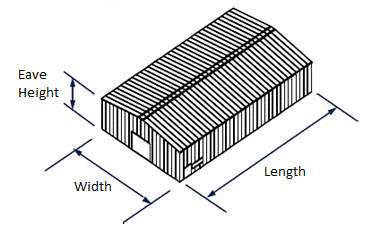
This is because the width of the building directly impacts :
- its internal layout
- Usability
- and design cost.
A narrow span might restrict floor movement, while a vast span increases framing requirements.
Now, let’s move on to understand how it begins :
- Determining width begins with analysing the purpose of the structure, including potential vehicle or machinery access.
- Engineers typically balance span size with steel thickness and bracing needs.
- Wider frames require more support, influencing foundation load and construction cost.
The chosen width must align with operational needs while maintaining efficiency in material use.
This is what creates a successful structure.
Calculate the Proper Length for Usage Efficiency
Length defines the capacity of a structure to accommodate equipment, inventory, or work zones effectively.
A thoughtful length assessment prevents overcrowding and ensures balanced distribution of internal features, making movements easier.
Builders often consider :
- available land area
- future expansion needs
- and design flow during this stage.
Longer layouts require reinforcement for wind resistance, preventing frame distortion over time.
The goal remains to achieve a proportionate length that complements workflow and environmental conditions.
Engineers fine-tune this parameter to maximize practicality and maintain structural equilibrium.
Set the Correct Eave Height for Performance
Eave height dictates some major factors :
- Clearance
- Ventilation
- and the building’s external profile.
It represents the vertical distance from the finished floor to the roof-to-wall connection point.
Whereas the height decisions depend on the interior purpose :
- Warehouses
- Workshops
- Agricultural structures all demand varied clearances.
Adequate height enhances lighting distribution and allows better airflow for large-span designs.
Higher elevations, however, increase exposure to wind and require additional reinforcement.
Selecting the right eave height ensures balance between visual proportion, functional clearance, and safety standards.
Evaluate Environmental and Site Considerations
The surrounding environment heavily influences dimensional planning.
For example, Terrain slope, neighbouring structures, and snow load zones affect building height and orientation.
For example, regions prone to heavy snowfall require adjusted eave heights to prevent accumulation. Builders assess solar direction to position roofs for maximum energy efficiency.
Key Environmental Factors Include:
- Local high-pressure areas
- Drainage systems and grading patterns
- Climatic temperature fluctuations
- Soil stability and foundation compatibility
Coordination with Structural and Design Experts
Professional consultation finalizes the dimensional blueprint of any steel construction. This is why Engineers and architects collaborate to align proportions with design codes and usage requirements.
Their role ensures proper load distribution, material optimization, and cost control.
Further, Communication clarity prevents misinterpretation of measurements and ensures the structure’s longevity.
Each professional input transforms a basic framework into a fully functional, high-performing facility.
Collaboration, therefore, defines accuracy and strengthens the entire design process.
Dimension planning shapes the strength, symmetry, and function of any steel structure. As a result, each element contributes to an efficient design that enhances appearance and longevity.
A precise approach to building a steel building ensures that every inch supports safety, value, and purpose-driven performance.
This thoughtful alignment of proportions ensures every structure stands as a dependable reflection of purpose, precision, and enduring craftsmanship.
Conclusion
Constructing a practical and functional steel building requires a lot more than just intricate and well-designed outlooks.
It needs accurate measurements so that no element is left isolated or incomplete.
In a nutshell,if you wish your building to stand upright, make sure you measure right!
FAQs
For example, if your tallest door opening is 20 feet, then your eave height should be 22 feet.